I know that many of you have expressed your interest and appreciation for my Odds and Ends posts, which are curated link lists of things that strike my fancy, or inform something I'm thinking about, but I'm slowly coming to the conclusion that perhaps I should step away from this particular category for now. I do like compiling the lists, and I appreciate the discussion that is often generated, either in the comments or in private, but I'm also finding the task to be burdensome right now, and I question whether continuing to discuss these topics in an online forum is really the best place for them. I know the internet has sort of taken a life of its own these last few years, and I'm concerned about how much discourse happens there and creates an echo chamber. Much of it is good, and does inform my thinking, educate my crafting, or simply enhance my world, and I think it serves a purpose, but I'd like to keep the boundaries a little more clear. Lately they seem blurry to me. I don't want to make some grand pronouncement about there never being another Odds and Ends post, but to say that they are on indefinite hiatus. Perhaps I will resume them at some point, perhaps not. I'm feeling pushed to make some small changes right now, and this is one of them. I think you may expect a bit less more generally from me in this space for a little while.

Showing posts with label odds and ends. Show all posts
Showing posts with label odds and ends. Show all posts
Wednesday, October 8, 2014

Tuesday, September 9, 2014
Odds and Ends, Vol. 13
I seem to have amassed another selection of great links, so here goes!
James Alexander Cameron is writing a dissertation on English churches, and his observations about medieval architecture mistakes are hilarious. I ended up subscribing to his blog on the basis of this article, but am enjoying his writing. I find his secular detachment from the sacred subject he is studying to be an interesting study in contrasts, as well as valuable commentary from the other side.
Related: this image haunts me.
Related: this image haunts me.
One of the original crunchy cons, Joel Salatin takes down Amanda Marcotte's whiny Slate piece about home cooked dinner. I agree with Marcotte that there are many obstacles to getting a good dinner on the table, but many of the objections she cites seem to me to fall under the category of #firstworldproblems. As usual, Salatin provides a farmer's perspective on these things:
"With slow cookers, indoor plumbing, timed-bake and refrigerators, today's techno-enabled kitchens allow busy people to cook from scratch and eat with integrity far easier than during Great Grandma's time. She had to fetch water from the spring, split stove wood, start a fire and churn the butter and she still managed to feed a large family very well. If our generation can't do at least as well with our 40-hour work week and kitchen tech, then we deserve to eat adulterated pseudo food that sends us to an early grave. I don't know that anyone's children deserve this, however."

Tolkien and goodness. I was reminded of a quote from Graham Greene's Bendrix in The End of the Affair: "happiness is even harder to write than goodness." From the article: "One of the reasons that Tolkien’s stories continue to inspire us is that he does something few authors are able to do: he makes goodness compelling and desirable."
This is real faith. Read the embedded link as well. Both are a powerful story of one man's unshakable faith in the midst of a terrible storm. God gives us much grace in the moment.
I read Wendy Shalit's book A Return to Modesty about nine years ago, and it had a pretty big influence on me. I've always been a fairly modest person, but her book helped me to feel good about it. She recently wrote an article about the troubling trend of nude selfies (so called s*xting), especially amongst teenagers, and why modesty remains important. Far from an antiquated notion, modesty is about protecting the private self. In our increasingly public age, maintaining and protecting this space is so important, and we have to teach ourselves and our children how to resist the allure of living everything out loud.

Yale has digitized a mass of photographs from 1938-1945, organized by county, and the database is fascinating! Click the county on an interactive map, and it takes you to all the photos stored for that county in the time period.
Amazon customer support gets creative with a disgruntled customer. I'm ambivalent about amazon these days, after the whole Hachette debaucle, but I will say about this particular exchange, well done!

Since finishing Cheap and reading Peter King's book, I've been thinking hard about what it means to my modus operandi, and while I don't yet have a global approach to the issues raised in both books, I have been thinking more about my shopping habits, my basic consumerist mindset, and how to change that to something pre-modern. I don't have any coherent answers yet, but I found Sarai's article on having restraint with fabric shopping helpful.
And in a related article: Design Sponge talks about cultivating craftsmanship and making mindful purchases. This is basically what Cheap is getting at, in the end, but it is hard to do on a large scale, given how the global economy works and the relative price of wages to quality goods.
Shana of The Mom Edit (formerly Ain't No Mom Jeans) shares a reader letter that is wonderful. The letter is about how sartorial sense is shaped by where you come from, and why it's hard to leave who you are behind.
Shana of The Mom Edit (formerly Ain't No Mom Jeans) shares a reader letter that is wonderful. The letter is about how sartorial sense is shaped by where you come from, and why it's hard to leave who you are behind.
I read a lot of germ theory history during graduate school, and I remain fascinated by medical history in general. A new study turns the current thinking about the progression of disease in the New World on its ear.

Evidence continues to pile in that people read differently on e-readers. I got a Kindle for Christmas last year, after much debate, and actually, I don't really like reading on it that much. I still prefer a physical book, and the highlights from other readers in the Kindle versions *really* annoy me. I did read some light things on the Kindle, and that was the primary purpose of it for me, but I can't do serious reading on it, and I dislike it for fiction reading that I want to attend closely to.

I don't even know how to caption this one, but these photos are fascinating.
I've noticed in the last few years that American culture lately puts a lot of value on artists, entertainers, creative types, etc., and I've wondered about whether this value was misplaced. It certainly puts a lot of pressure on non-creative people to be so. I consider myself a fairly creative person, at least in the sense that I like to make things, but I find the way that creativity is currently valued very frustrating. When every second show on television is a campy reality show, and all the world is a Facebook stage or a Pinterest pin, it is hard to find private space, to create for the sake of it, to enjoy natural beauty. I find that Pinterest really exacerbates this for me, which is why I rarely go on the site. It just makes me unhappy. As it happens, modern notions of creativity as a force to be unleashed within the self are very recent, and not only was creativity not valued in earlier times, it was not even understood to come from within. Joshua Rothman explains. From the article:
“Every culture elects some central virtues, and creativity is one of ours. In fact, right now, we’re living through a creativity boom. Few qualities are more sought after, few skills more envied. Everyone wants to be more creative—how else, we think, can we become fully realized people?...This watchful, inner kind of creativity is not about making things but about experiencing life in a creative way; it’s a way of asserting your own presence amidst the much larger world of nature, and of finding significance in that wider world. By contrast, our current sense of creativity is almost entirely bound up with the making of stuff. If you have a creative imagination but don’t make anything, we regard that as a problem—we say that you’re "blocked.""
and more:
"It sounds bizarre, in some ways, to talk about creativity apart from the creation of a product. But that remoteness and strangeness is actually a measure of how much our sense of creativity has taken on the cast of our market-driven age. We live in a consumer society premised on the idea of self-expression through novelty. We believe that we can find ourselves through the acquisition of new things. Perhaps inevitably, we have reconceived creativity as a kind of meta-consumption: a method of working your way toward the other side of the consumer-producer equation, of swimming, salmon-like, back to the origin of the workflow."
Read the rest.

Amazing night photography.

And more (different photographer and technique)
Long time readers of the blog will know that I lived in Russia for a time about 12 years ago (in addition to a student semester there in college), and that experience was quite formative for me. I still miss living in Russia, and the arrival of fall always makes me miss it more for some reason. I keep up with Russian news and to a lesser extent, Russian politics. I want to revisit my Russian language learning at some point. So it goes without saying that this article about the rising mortality rates in Russia since 1992 piqued my interest. It turns out that the larger picture is one deeply rooted in the history of the Soviet Union, one that as a Soviet historian, I find very interesting.
Amazing night photography.
And more (different photographer and technique)
Long time readers of the blog will know that I lived in Russia for a time about 12 years ago (in addition to a student semester there in college), and that experience was quite formative for me. I still miss living in Russia, and the arrival of fall always makes me miss it more for some reason. I keep up with Russian news and to a lesser extent, Russian politics. I want to revisit my Russian language learning at some point. So it goes without saying that this article about the rising mortality rates in Russia since 1992 piqued my interest. It turns out that the larger picture is one deeply rooted in the history of the Soviet Union, one that as a Soviet historian, I find very interesting.

Thursday, August 14, 2014
Odds and Ends, Vol. 12
 |
| Image |
I think anyone who has read this blog for any amount of time knows that we struggle with whether or not the city is ultimately the best place for our family. We love many aspects of city life, and there are many ways in which our family life would radically change were we to decamp to the country, not all of them good for our kids. With that in mind, I found this article to be particularly thought-provoking. It is an interesting book review on the changes wrought in Lancaster County and in rural life in general over time. We recently spent a day in Lancaster, visiting some friends, and the place has its allure, and I completely understand why those fleeing the hardships of urban life would find it appealing. It is tempting, however, to bring urban sensibilities to the farm, and it is not fair to do so. We urban dwellers must consider ourselves outlanders when we leave the city, and to keep our own counsel, for just as we would bristle at a farmer telling an urbanite how to go about things, so the farmer has the right to feel put upon by city folk doing the same. From the article:
"Although the problems facing rural communities like Lancaster have serious economic causes, I argue that their root is primary cultural. In the twentieth century, the city has replaced the country as the focus of American culture, and ruralites wanting growth and progress have looked to urban models. As American society has moved further from its agrarian roots, ruralness has come to be associated with the past, with a simpler time of peace and plenty when harmony prevailed.
This idea of the city-as-future and the country-as-past has aggravated the troubles of rural America since the Second World War. When urbanites see a rural community as an attractive lost Arcadia, their money can serve as a wedge for their ideas and force ruralites to accommodate their desire for peace, quiet, and recreation. Farmers and other rural residents needing to make a living are often forced to the opposite extreme, advocating progress at any cost; while ruralites who want to preserve farmland and other open space from development may be seen by their neighbors as catering to urban fantasies or as “living in the past.”
Americans’ failure to envision a model for rural progress—a present and a future that preserve the essential character of a rural place—has allowed the city to turn the country into a kind of economic and cultural colony."


10 Things No One Tells You About Marriage Beforehand (but they should!) This is an excellent little exposition on how our culture's messages about marriage are thoroughly mixed up and also explains a better way to approach the marriage relationship.
Dwija talks about how hard it really is to be a stay-at-home mother, especially at the beginning. Preach it, sista.
I'm not sure what I find most disturbing about this article: the fact that a two year old is asking Siri what an ear infection is instead of asking his father, or that the father is directing the pediatrician's questions about the child's malady to the child instead of being tuned in enough to the child's symptoms and illness to answer them himself. The child is two. In any case, a good reminder to leave the mobile device in the purse, on the counter, somewhere out of reach when spending time with kids. Because, man. Those dopamine receptors. No respecter of persons.
Kara Tippetts is dying of cancer, but is making the most of the time she has left. May we all face our ends with such serenity, such grace, such fortitude.
Brilliant entertainer Robin Williams is dead of apparent suicide; his demons got the best of him, and I'm sad for the suffering and mental illness he endured for most of his life. I found this little response to the news timely and useful.
Brilliant entertainer Robin Williams is dead of apparent suicide; his demons got the best of him, and I'm sad for the suffering and mental illness he endured for most of his life. I found this little response to the news timely and useful.


I'm only going to link a few articles here from this website, but please read the whole series (links at the bottom of the page). It is a fascinating look at the garment industry from an insider, specifically addressing the problems of fitting and sizing, a topic that I think you'll agree affects all of us. She talks about why vanity sizing is a myth (and I really do buy her argument), and why sizing is so frustrating to most people. She offers some ideas to help, but we consumers also have a part to play--we need to be honest with ourselves about our measurements, and to have more realistic expectations from the garment industry as to what can be offered given demographics, economic reality, price issues, and so on. From one of the articles:
"What it really boils down to is consumer expectation that they should be able to walk into any store, anywhere and pick out a medium and expect it to fit them but that’s just not reasonable. Particularly when many consumers are reluctant to pay the customary price points of that market. For example, it’s unreasonable for the average Wal-Mart customer -who only wants to pay Wal-Mart prices- to walk into Talbot’s and expect a Talbot’s medium to fit them and their pricing expectations so it’s unreasonable to expect every manufacturer to fit the full range of human size possibilities too. With companies free to fit “their” customer, you have more possibilities of locating a size that fits you than if sizes were standardized."
In short: not every retailer can or should serve everyone. (For more information, please read this brief article on why J.Crew is offering XXXS clothing line)
I wrote earlier this week about modern retailing, and the problems of finding quality goods at a reasonable (note, I did not say "cheap") price. I think for those of us who love vintage clothing or second hand furniture, shopping can become a bit of a problem. With most other retailing, there is a sort of assembly line quality to it, and the almost sure knowledge that something similar (or possibly better) will come along if you don't buy it now. With vintage, the unique nature and rarity of it can inspire impulsive purchases, or even just ill-considered purchases. I've been guilty, guilty, guilty of this, and I'm working to reexamine my shopping habits, particularly online, as I'm noticing that I've increasingly used it to self-soothe during times of stress. At the end of the day, they are just things, and things are ephermeral. We can't take them with us, so to speak. Emileigh wrote an excellent post on the topic last week.
 |
| Image via |
This is kind of cool: an artist's installation of a corner shop, all made of felt.
Putting on new perspecticles about the blessings in our lives (I go back and forth about Glennon Melton, but this one is worth a read; besides, she uses one of my favorite quotes: Beware of all enterprises which require new clothes.")
How to eat well on a food stamp diet. (includes a free full color downloadable cookbook). I love projects like this--each meal is under $5, full of healthy nutritious ingredients, with easy substitutions for what is available, on sale, and reasonable to prepare.
Diligence, hard work, and a willingness to put up with hardship and scorn of the surrounding community are the ways out of poverty, but in the current cultural and political landscape, it is hard to effectively convey that message.
 |
| shorpy.com |
The news from the Middle East is fairly horrific these days, especially for Christians. I'm not always sure where to go with any of it--the wholesale slaughter of ancient Christian communities in Iraq and Syria has left me bewildered and fearful for the future. Molly Sabourin provides a thoughtful response, as usual.
On a lighter note, Shana gives great tips for making a kid-friendly space in the back yard, and (most importantly, in my opinion) leaving them to it.
I've always said that crafting is as good as therapy (although probably not cheaper, once you factor in supplies). Turns out, it is true!
 |
| Image via |
A history of working class gardens in England. I find this brief overview to be quite fascinating, particularly in light of several documentaries I watched recently on some grand estates in England, including Hampton Court, Althorp and Chatsworth.
If you are J-type personality like me (on the Myers-Briggs scale, this means someone who likes routines, closure, plans, control, etc), then you might find your to-do list can sometimes feel overwhelming and stressful, particularly those sorts of items that never seem to be "finished" or recur regularly. I'm still thinking about Tasha Miller Griffith's novel approach to the infinite to-do list.
I didn't realize this until recently, but pink peppercorns are related to tree nuts like cashews, so if you have a serious tree nut allergy (and I do!), please avoid them! They show up in fancy peppercorn mixes, and chefs often use them in nicer restaurants. I've often had "x-factor" reactions, where I reacted to something I ate but had no idea what the culprit could be, even when I'd made or vetted the food myself. I'm now wondering how often it was something like a pink peppercorn.
Interesting: Carlo's Law of Metaphysics.
I'm quite fascinated by Jonathan Haidt's Moral Foundations Theory, and a recent thread on Rod Dreher's blog prompted a comment by Haidt himself, which then led off into a series of questions about the arts. I'm still thinking about it.
Does language shape how we view the world? This post neatly ties together several of my interests, including time, cultures, language, and history. I do think that language has a direct impact on our thinking, mostly in that when we have more words to express our complex inner lives, or to describe our world, we can make better sense both inwardly and outwardly. I have several phrases I can only use in Russian, because they don't translate. Ditto for a few Dutch phrases I grew up with. Yes, I can more or less explain what they mean in English, but the words in the original have a richness, a savory character on the tongue that feeds something deep in me.
The future of modern Islam and American Laïcité (this article is interesting because it is written by a second generation immigrant and follower of Islam, but really, you could insert almost any religion into the framework he describes).
In light of my recent fascination with all things related to the Great War, I was pleased to find this little gem in my newsfeed recently. It is a photographic history of solider's kits from 1066 to the present. The presentation is wonderful, and the progression fascinating.
 |
| Solider's Kit from Battle of Somme. Image via |
And in related Great War remembrances, poppies to remember the fallen at the Tower of London. (Incidentely, I highly recommend the documentary on the Secrets of the Tower).

"The Allied and Central powers depicted themselves as uniquely chosen by God to fulfill a civilizational and religious mission; demonized their enemies as Antichrist or Satan; portrayed the war as a Manichean struggle between good and evil; and promised world redemption if they and their allies triumphed, and nothing but human bondage and misery if their enemies prevailed.
Apocalypticism, encouraged by the war’s length, widening scope, and destructiveness, appeared in wartime novels and movies, animated radical political movements, and fueled end-time speculation made even more plausible among fervent premillennialists by the British army’s victory in Palestine—at biblical Armageddon, no less—and by the Balfour Declaration’s promise of a homeland for the Jews. This was a war of prophetic fulfillment."
Thursday, July 31, 2014
Odds and Ends, Vol. 11
 |
| Via |
The War That Changed Everything. The Wall Street Journal reflects on the impact of the Great War. Consider this article a good primer to understanding the modern and post-modern landscape.
Meagan Francis addresses some tricky parenting dilemmas for older kids. My kids have a few years (I hope!) before these things become an issue, but I'm going to keep this article in mind as we hurtle along.
Nathan Bieberdorf puts paid to the notion that everything is beautiful. There is much in life that is valuable above physical attributes, and frankly, not everything in life is beautiful. There is much ugliness and sorrow in the world. From the article:
"Because we have created a culture that values beauty above all other innate traits…for women, at least. Men are generally valued by their success, which is seen as a result of talent and hard work, despite how much it depends on luck and knowing the right people.
But women are pretty much a one-note instrument. Society says, you’re hot, or you’re not. Your looks affect your choice of mate, the friends you have, and even your job. And this factor that will affect every part of your life is something you have next to no control over."
Sally McGraw at Already Pretty discusses how to define your body (or, as I've said before, appreciate your body's own particularities; it is so much easier to find or sew clothes that fit and flatter if you are comfortable with your own skin and familiar with your particular shape and proportions)
I've noticed this trend in the last few years of women plasticizing themselves, partly (I think) in response to the preponderance of Photoshopped, airbrushed magazine ideals. I loved this video response by singer Colbie Callait.
Sarai reflects on the 3 biggest joys of sewing.
The Rule of Three for keeping wardrobes functional and small. I'm definitely using this rule going forward.
Without the devil, without sin, there is no reason for salvation, no reason for Christ to save us. The Church of England seems to have forgotten this basic fact.
A plutocrat warns against modern day peasants storming the castle. Hanauer's thoughts on employment, wages, and economics are fascinating, particularly coming from someone as ultra wealthy as he is. (Also, Rod Dreher has a nice response to the article, along with a good reflection on folly in society)
Philip Bess might just be my new favorite intellectual. He is a New Urbanist, and his thoughts on sustainable community in the 21st century are spot on. I particularly appreciated his thoughts on the role of the Church in creating community around itself, rather than asking the community to come toward it. Christ comes to us; the chalice proceeds from the heavenly altar, all we need do is approach with fear and trembling.
On the other hand, one of the reasons I love being an historian is that I like to imagine life as it was before, and imagine myself back in that life (this is one of the primarily reasons that Outlander strikes a major chord with me). Turns out, I could be living the medieval dream. Oh, don't tempt me.
 |
| Via |
I love this: 50 photos of motherhood in the mid-20th century. Further proof (as if we needed it) that women come in all shapes and sizes, and how mothers interact with their children remains unchanged.
Every time I go to IKEA, I get visions of compact, simple, streamlined aesthetic in my head. Those showroom apartments where every square inch of that 700 square foot apartment is utilized, and livable for a family! The 100 square foot studio apartment with no wasted space. So cozy, so compact, so useful! But then I get home, and see the realities of my Victorian-era row-home, and realize, the Scandinavian modern aesthetic isn't going to work here. But I can dream! This slide show takes me away.
Alan Jacobs reviews Jonathan Haidt's Righteous Mind. Haidt is a leftist secular scholar, but he understands how institutions bind us together, make us feel morally superior, promote group-think, and also prevent good dialogue between opposing sides. Jacobs nicely summarizes Haidt's arguments.
This article deals with a question that is often on my mind: waste. Specifically, textile waste, as fast fashion has ruined the textile industry, garments aren't made to last, and the consumer mindset of modern society pushes us to buy ever more clothing (the average American buys 70 pieces of clothing per year!) All that clothing tends to cycle in and out, as fashion trends change quickly these days, and garments are designed to wear out in three washes (!!!). I wish more companies would get involved in textile recycling in America, as I think there is not only big business there, but it would at least be a buffer of sustainability in a sector of the economy that seems little concerned with the environment. The first step, obviously, is to consume less, but I get that it is hard when garments are poorly made and wear out easily (even the ones from so-called "good" brands are no longer as well made as they were even 15 years ago). I do donate almost any clothing we aren't using anymore. I consign whatever is in good shape to ThredUp, and donate the rest to a local charity, where I presume a lot of it is recycled. I haven't done as well with garments that are beyond the pale (mostly clothing from my husband, who wears things completely dead), but this article makes me think I should just be donating them as well, marked for textile recycling.
Dreher skewers the notion of "the right side of history" and the idol we make of it.
Caroline Vuyadinov discusses the body after death--it is not disgusting, or a casing to be discarded, but the housing of the soul, and should be respected, and buried properly.
Dreher was on a roll there for a few weeks, and this article caught my eye: why hard news is like eating kale. From the article:
"The ugly truth is that people consume news like my kids consume food: they hate anything that might be remotely challenging or unfamiliar, and all things considered, they’re rather eat sweets than meat or vegetables."
 |
| Via |
Ingenious ways to hide the "ugly" in your house. I don't actually think most of these suggestions are practical, or even that attractive (hello, dog bowls in a drawer. Ick), but some are clever. I also think that we don't need to hide the "ugly" in our homes--we live there, they don't need to look like an unoccupied magazine spread. That said, there are plenty of practical reasons to tie up cords, hide them behind things (to keep Small People out of them, for example), and some of the ideas listed are useful.
And related: A manifesto against the tyranny of luxury kitchens. Yes. Exactly. Give me small, functional, and perhaps ugly or dated to empty, unused, expensive showpieces.
Bigger is better, when it comes to managing a family.
As the mother of four small children in a child-hostile urban setting, I've received my fair share of weird comments over the years. Wendy Jenssen hilariously responds to the most common (and sometimes bizarre comments she receives). Also, Scary Mommy skewers them all. Just.don't.go.there, mkay?
I'm not militant about breastfeeding, but I do think that women should feel free and comfortable to discreetly breastfeed in public. Julia Wykes' story made me sad about the whole thing.
In an older article, Frederica Mathewes-Green discusses the pros of (wed) teen pregnancy. The key? A supportive surrounding community.
 |
| Via |
Have I cracked on enough about Outlander yet? No? Good. Here are the reasons we care about Claire (the main protagonist of the series). Series premier on August 2!! First episode is free on Starz.com--I can't wait!!
Our society is profoundly uncomfortable with, well, discomfort. Anything that isn't shiny or pretty, or fit into a nice category is hard to deal with, and grief or personal tragedy is no respecter of persons. I found this little infographic a useful way to think about how to help when life gets tough, and what not to say.
Nichole talks about the reality of parenting small children. Her best observation?
"In the modern world of shiny blogs and perfect Instagram photos and everything we want when we want it, there is a great fiction that we can control everything around us, so that we’ll never experience discomfort. According to modern society, discomfort is the worst thing that can happen. But parenting little people will involve difficult, sometimes painful stuff. Most of it is amazing, wonderful and unimaginably fulfilling, but not a small amount of parenting is dealing with challenges you have no way to prevent. Stomach bugs happen. Tantrums happen, mostly in public places. Sleepless night HAPPEN, oh those sleepless nights. Parenthood comes with a higher level of discomfort than almost anything else you’d willingly choose. Our society asks the question, why chose parenthood if it sucks so much?"
Yes, exactly. But, as she notes, parenthood is filled with much joy and love that balances out the discomfort, the sleep-deprivation, the anxiety, the agony. It is good for our souls to choose things that are difficult, things that are uncomfortable, things that hurt. Sometimes we can grow and change no other way.
Monday, June 16, 2014
Odds and Ends Vol. 10
| 1940s cherry pickers |
Time for another Odds and Ends!
20 interesting ways to reuse old things. The bathtub couch is kind of intriguing. Slightly weird, but intriguing.
 |
| Via |
I've been watching the Starz production of The White Queen lately, which is set during the War of the Roses, shortly before the Tudors took the throne of England for good, and I found this article on England's Game of Thrones fascinating.
Gracy Olmstead considers the pros and cons of suburban life. I've really enjoyed everything I've read by Olmstead, as I find it to be quite thought-provoking, and often in a direction I'm already thinking about. I think we've pretty much made our peace with staying in the city, but this article gives reasons why it is okay to like the 'burbs.
I'm not going to post the photo here, as I'm not looking for search engine bait, but I think by now many of us have seen the viral photo of a very fit mom of three under three, with the title "What's Your Excuse?" This photo bothered me on a number of different levels, although I couldn't exactly articulate why. Mat. Anna pretty much says it.
The Nife En L'Air writes about how seeking perfection in everything around us can interfere with contentment. As a person who struggles with perfectionism, this post resonated with me.
 |
| Unbelievable underwater landscapes Via |
The Nife En L'Air writes about how seeking perfection in everything around us can interfere with contentment. As a person who struggles with perfectionism, this post resonated with me.
My friend Beth posted a Parent's Prayer. Yes, yes, yes.
Hollie Klaassen tackles the tough world of high-needs babies and young children. This post brought me back, helped me better articulate to myself my children and my mothering experience, made me cry a little, but also made me realize that I'm not alone.
My friend Michelle responded to the Ms. Klaassen's post with a series of her own, discussing the isolation of parenting high needs children, but also the joy.
The heart of the Russian home is usually in the kitchen. NPR discusses how dissent and counterculture flourished there under the Soviets. I love the kitchen culture of Russia, and miss it very much.
 |
| Wonderful Photography of Peter Essick |
The heart of the Russian home is usually in the kitchen. NPR discusses how dissent and counterculture flourished there under the Soviets. I love the kitchen culture of Russia, and miss it very much.
Kristen at Rage Against the Minivan sends up lifestyle blogging. And those perfect Pinterest houses. With aplomb.
This is just funny: A Manifesto Against Luxury Kitchens. Snark, snark, snark. Can I just note that in my experience, these fancy, expensive showroom kitchens tend to be showpieces, vastly underutilized, while the kitchens that people actually cook in tend to be inefficiently laid out, small, and cramped. But they have the essentials: a stove, a fridge, a sink, and a place to chop things. One hopes.
10 Ways to Stay Sane on the Internet. I think it is fair to say that we aren't going back to a non-Internet type existence any time soon. This post lists good ways to set boundaries, keep it real, and at arm's length.
Let's all try to be courteous with our phones. Pretty please?
In a related article, Rod Dreher discusses the role of the Screen in our culture and lives. His conclusion is a little ambiguous, but I think that is the point. Many of us have an uneasy relationship with the Screen, but it does enable a great number of things that make our lives easier, but that comes with a cost too.


If you are a Lord of the Rings fan, you must check out this Tumblr, which has the Russian illustrations from someone's childhood edition. Stunning.
 |
| Via |
And we can't do this thang without talking a little shop, so bear with me. Jennifer Lauren shared an excellent post as part of Me Made May (more about that later) on building a wardrobe of handmade clothing that we actually wear.
Anastasia Basil blasts Minnie Driver and our whole culture that fetishizes women's looks above all else. (warning: strong language)
I ran across this post on how to understand body type and proportion shortly after reading Basil's piece, and it confirmed to me that understanding the quirks of your own body, and just being honest and open with yourself about what is under your clothes is the best way to flatter your body and feel good in clothing. If you don't understand your body's quirks, you are always going to be frustrated with clothing.
Sarai discusses why shopping can be such a dissatisfying experience (and I would add that her observations apply to more than just clothing, but rather our whole consumerist mindset) and offers a way to channel desire into creativity.
And if you've made it this far, you might as well check out Gracy Olmstead's piece on developing a longer attention span for reading. (Hint: it isn't by reading War and Peace)
Monday, May 19, 2014
Odds and Ends, Vol. 9
I've got another great line up of articles for you, and it has been so nice to hear from several readers that you are enjoying these links!

Sarai at Colleterie has been collecting links on simple life and finding contentment in the everyday, and I found this article on the medium chill to be a useful perspective, particularly as I'm a satisficier in some areas of my life, but a perfectionist in others. Equally intriguing is this short piece from The Nife En L'Air that pokes holes in our ideas of simple living (hint: it's not an aesthetic, and it's not necessarily something you can easily Pinterest).
Mat. Anna posted a short story a while back, and I found it such a useful way to think about saying the Jesus Prayer.
Amazing color photographs of pre-revolutionary Russia. The color makes them seem contemporary and close enough to touch.
 |
| Via |
Rod Dreher ponders the collapse of the American family in the last 40 years. What is especially interesting is reader Anastasia's comments included at the end of the piece. Indeed.
Ivan Plis writes about the dangers of seeking Christ through the internet instead of by living the life of the Church and the liturgical cycle. I've encountered this phenomona many times over the years, and it is still worth repeating: The best way to learn about the Orthodox Church is to live it; go to the services, participate in the cycle of fasting and feasting, pray the prayers, read the Fathers (not online!), go to monasteries. This is the way of discipleship.
Also in First Things, John P. Burgess writes about the modern Russian Orthodox Church, and the complex legacy of the Soviet period and how that is being worked through today. From the article:
"But the story of the Church’s rebirth is more complicated than Western analyses suggest....The biggest impediment to success is Russians’ low rate of active participation. Although as many as 70 to 80 percent call themselves Orthodox and have been baptized, only 2 to 4 percent regularly attend the liturgy. Even fewer keep the Church’s fasts. Still, sociological surveys have established that Russia is one of the few places in the developed world where people report that religion is becoming more important to them, not less. I am constantly surprised by Russians like my friend Tanya. A well-educated and professionally successful Moscow resident, she questions the existence of God, never attends church services, and doesn’t even know the Lord’s Prayer, yet makes pilgrimages to remote Orthodox monasteries, where she says she experiences a holy world that fills her with utter joy and peace. For her, a low rate of everyday participation clearly does not contradict a high degree of affective affiliation. The Church believes that the explanation is both simple and powerful: Orthodoxy helps Russians understand who they are as a people and what makes Russia unique among the world’s nations."
 |
| Via |
An Atlas of True Names: this is quite interesting, as it identifies place names by geography and history, rather than a random name. For instance, Ohio is called the Land of the Large Creek, and Pittsburgh The Pit-Dweller's Town. I'm geeking out over here.
Kelly Flannagan talks about how our cultural American Protestant work ethic might lead us to teach the wrong lessons about what is important to our children. I think he gets at something important, which is, yes, you can accomplish many things through hard work alone, but there is a cost to doing hard work at the expense of everything else in your life.
I found these paintings of the sea by Samantha Keely Smith oddly mesmerizing.
 |
| Samantha Keely Smith |
The Farmer's Wife offers a useful corrective to us mothers who feel pressure to do it all, be it all. In short? Prioritize your children's hearts, be very selective about what you read about parenting on the web and in books, don't be your children's primary entertainer, and define your own fun. All good rules to live by, and most of her guidelines are things we are trying to do at our house as well.
Protopresbyter Vasile Tudore writes about how living in the information age can get in the way of our spiritual life. From the article:
"This avalanche of information about everything and anything has turned all of us into information junkies. We constantly check our phones waiting for the next piece of news or conversation to pop out. We live and breathe information. There is only one downside to this addiction, we start having less and less time. Paradoxically, when we can find anything quicker than ever, we end up having less time than ever. Work doesn’t get finished, conversations, unless virtual, are on the brink of extinction, human interactions are a bare because they take you away from the urge to know everything right now!" I'm still working on balance with my computer use, and I find it a tricky line to walk, because I have a lot of social interaction online that I wouldn't get anywhere else, and I do a lot of our household shopping online, but I'm trying to be more mindful when I'm online, and ask myself, am I here to create, to work, to contribute? Or am I here to numb, to tune out, to ignore my life? If the latter, I try to turn off the computer and do something else.
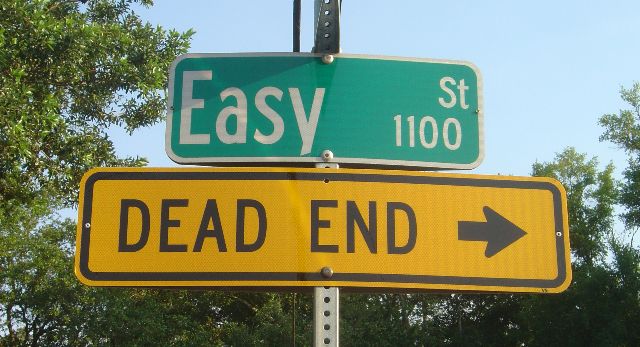
Sometimes, I think Christy lives in my head. I'll be thinking about writing something, and then she goes and says it better than I ever could! A few weeks ago, she wrote a quick take (#2) about how searching for "easy" in every day life can be a pitfall. It is something I've been thinking about a lot lately too--I think we do a disservice to the hardships of life by constantly praising and seeking out that which is easy. There is much in life that is hard, and while I don't think we should seek out hardship for the sake of it, neither should we ignore difficulty, or pretend it doesn't exist, or that there isn't something spiritually useful to working through hard things, or learning how to master a skill that is difficult. I think there is more to say on the topic, but I'll leave it there for now and perhaps revisit it soon.
I seem to be stuck on images of the sea lately. This photograph is amazing.
 |
| Jem Cresswell |
I started out my history career in the medieval period, and so I'm always drawn to articles and stories from that time period. I found this myth-busting article about the Crusades to be so illuminating, especially for our current relationship with the Muslim world. Turns out, what goes around, comes around. But then, we knew that, didn't we?
 |
| Via |
Finally, Rod Dreher continues with an ongoing theme of storytelling with a brief post. At some point, I need to parse this out, as it is a theme I think about a lot: who I am, how the stories I tell about myself are influenced by what others have told me, how my thoughts about who I am are shaped by those stories, etc. I read a fascinating book a few years ago that raised a lot of these questions for me called What Alice Forgot. Stories have a tremendous ability to define us, to narrate our lives, and the stories we tell and how we tell them are important.
In a related note, we are entering the great big world of audiobooks for kids, and having listened to Danny Kaye's fabulous retelling of several lesser known fairy tales ad nauseum, we have discovered the wonderful storytelling of Jim Weiss. We listened to his narration of King Arthur's Knights on our way to church yesterday, and after church, I went on Amazon to find more of his recordings because he is a wonderful storyteller! We also ordered the first Adventures in Odyssey, as I remember those stories from my own childhood, and remember them being entertaining for adults too. We have several car trips planned this summer, so we need good listening material--the kids are so quiet when there are stories on!!
And two more:
Gracy Olmstead writes about not idealizing pastoral over place, and in an excellent linked piece, also compares Thoreau and St. Benedict's approach to simple life. Skip Waldon Pond and go for Benedict, I say. There is so much I want to say about these two articles, but I'll save it. Just read them!!
And two more:
Gracy Olmstead writes about not idealizing pastoral over place, and in an excellent linked piece, also compares Thoreau and St. Benedict's approach to simple life. Skip Waldon Pond and go for Benedict, I say. There is so much I want to say about these two articles, but I'll save it. Just read them!!
Tuesday, April 22, 2014
Odds and Ends, Vol. 8
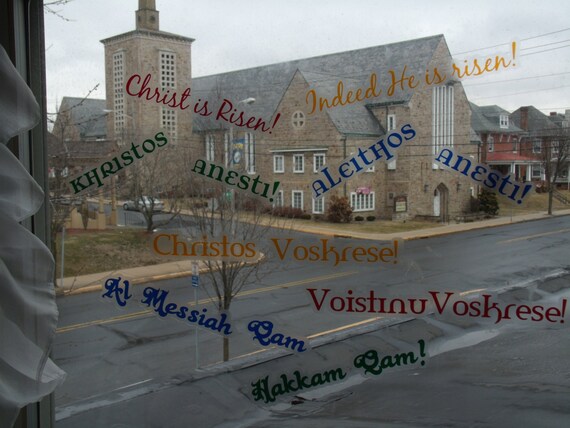
Christ is Risen! Indeed He is Risen! A very happy Bright Week to us all. I mentioned last week that I had another Odds and Ends in the hopper, and so I do! A great list of links for your reading pleasure.
 |
| photo via Lettuce Lift Up |
Even though we are just past Holy Week, and all its temptations and trials, I still think this article is worth reading and thinking about: Work, Rest and Holy Week. I think the lesson can be applied throughout the year.
Vladimir Denshikov's amazing knotted linen icons. Stunning, just stunning. Be sure to look at all the photos and take in the detail to fully understand the intricacy of his work.
This article had me at "overwhelm". Brigid Schulte talks to a staffer at The Atlantic about her new book, which discusses why Americans are so stressed out, tired, overworked and yes, ovewhelmed all.the.time. The article is geared more to women who work outside the home, but honestly, I know just as many SAHMs who would find themselves in this article, myself included. From the article:
"We all feel like we’re not doing enough for our children, so in our guilt, we do, do, do, and overdo: more lessons, more teams, more sports, bigger birthday parties, more educational outings. And we all feed off each other—particularly as we look to the future, see a changing global economy and so much uncertainty about what “success” will look like. There’s so much fear and we’re so worried that our kids will somehow be left out, or left behind. That’s part of what fuels the craziness of the parenting merry go round.
Vladimir Denshikov's amazing knotted linen icons. Stunning, just stunning. Be sure to look at all the photos and take in the detail to fully understand the intricacy of his work.
 |
| Vladimir Denshikov, via |
This article had me at "overwhelm". Brigid Schulte talks to a staffer at The Atlantic about her new book, which discusses why Americans are so stressed out, tired, overworked and yes, ovewhelmed all.the.time. The article is geared more to women who work outside the home, but honestly, I know just as many SAHMs who would find themselves in this article, myself included. From the article:
"We all feel like we’re not doing enough for our children, so in our guilt, we do, do, do, and overdo: more lessons, more teams, more sports, bigger birthday parties, more educational outings. And we all feed off each other—particularly as we look to the future, see a changing global economy and so much uncertainty about what “success” will look like. There’s so much fear and we’re so worried that our kids will somehow be left out, or left behind. That’s part of what fuels the craziness of the parenting merry go round.
And as for chores—man, all you have to do is open up any magazine and you’ll see that, for women, you can never be enough. Debora Spar, president of Barnard, called it the “triple whammy” in her recent book Wonder Women: Sex, Power and the Quest for Perfection. You have to keep house like Martha Stewart, parent like Donna Reed, work like Sheryl Sandberg, and look like Jennifer Anniston. That’s nuts. We all know it’s nuts, and yet it’s hard to break away from those cultural expectations." Yes, yes, yes.
And more:
"How to try to live and work in a sane way when you’re in the middle of insanity: a voracious workplace that will eat you alive, friends and neighbors who raise eyebrows if you pull your kids out of some competitive activity. He gave some important advice: Create your own community, a network of like-minded people. Humans are wired to conform—that’s why these cultural pressures, however silly they may seem, wield such power over us. So find a group that fits your values that would make you happier to conform to."
This has been our goal since day one of having children, since we knew we were going to making choices against the grain, and while we are still seeking out like-minded individuals, we are starting to have a nice little group around us.
Tired of trying to make childhood magical? Yeah, me too. (Although in truth, I was never trying that hard to begin with) I think this article applies not just to raising children, but to a general attitude toward life, which is messy, difficult, and not usually magical. To find beauty in this life, we must actively seek it out, not passively wait for it to find us. "When we make life a grand production, our children become audience members and their appetite for entertainment grows. Are we creating a generation of people who cannot find the beauty in the mundane? Do we want to teach our children that the magic of life is something that comes beautifully gift-wrapped -- or that magic is something you discover on your own?"

Dreher discusses living in the Christian shadowlands--the post-secular landscape of belief/unbelief that characterizes our society. A good commentary, and a nice jumping off point for an online discussion that has been making rounds in Orthodox circles about raising children who stay faithful.
In related parenting articles: Raising A Moral Child (it's trickier than you think) We all want our children to be kind, compassionate, and helpful, but teaching them to internalize these values is a little bit hard. This article tackles the why and offers some ways to help.
In related parenting articles: Raising A Moral Child (it's trickier than you think) We all want our children to be kind, compassionate, and helpful, but teaching them to internalize these values is a little bit hard. This article tackles the why and offers some ways to help.
Sometimes being a student of history is useful for putting things in perspective, and sometimes it is just a scary reminder that what goes around comes around. Benjamin Lockherd discusses how the common mind (and with it a sense of shared civil society) is at risk of falling away.
And in further esoteric news, the internet is ruining Big Words. People no longer learn them, and they don't fit nicely into 140 characters. This makes me so sad. Sometimes complex words are the best way to convey an idea, or to express oneself adequately. Narrowing language by definition narrows the mind. That said, I do agree that one shouldn't use big words simply for the sake of using big words, or to obfuscate. (how's that for a doozie??) One should be clear, precise, and yet maintain richness and complexity.
 |
| Via |
I've known for a long time that the garment industry does a number on women's psychology with sizing and numbers and so forth. One of the reasons I like sewing for myself is that I'm very familiar with my measurements, which are a better indicator of size, rather than a randomly assigned number on a tag. I found this article to be particularly illuminating about the whole rigmarole. In short? We'd be better off giving some random non-numerical assignation to sizing, because it really means nothing. In a somewhat related article, fozmeadows unpacks the bad science behind BMI as a measure of health, and how the number on the scale is only one factor.

I think a lot about clothing (clearly), as it is such an obvious point of self-expression and even, dare I say it, a kind of stress outlet for me? Sewing and knitting my own clothes gives me such an outlet of creativity and tactile satisfaction, and I love the thrill of the thrift hunt, and finding reasonably priced vintage clothing that fits me well is such a treat. I'm increasingly disturbed by the waste of the modern fashion industry, and was distressed to discover that most "fast fashion" clothing isn't designed to last more than three washes! It has certainly given me pause to reconsider those "bargain" purchases, and to think even more about sustainable living, particularly in regards to clothing. I'm sure there's another blog post in there somewhere.
 |
| Downtown Abbey costume exhibit at Winterthur (photo by me) |
I was thrilled to discover that someone is doing something positive to combat the hyper-sexual message of fashion for young girls. You can bet I'll be patronizing this young woman's business when my girls get to be that age.
Carolynne discusses the minimalist approach to wardrobe, both for women and kids. (Links for all the articles in the series are at the bottom of the entry).
 |
| Via Chronically Vintage |
Jessica shared some fantastic rare color Edwardian photographs a few weeks ago. It is interesting to me how a color photograph makes the people in them seem less remote to our time. I also found a pinterest page for early autochrome photographs that was equally fascinating.
Jen Fulwiler on 5 Big Ideas that changed her life. Jen is ever the good one for looking at forests instead of trees, and I found this article particularly thougtful.
Jessica Griffith talks about how cultivating an attitude of gratitude in one's children is overrated, and may possibly be the wrong approach all together. This article resonated with me quite strongly, as I'm somewhat prone to feeling put upon, and wondering why my children don't seem to notice or care about all the things I do for them all the livelong day. The point? It's not about me. Duh.

This one is important: My longtime friends, the Wilsons, have just adopted a darling little girl from the Democratic Republic of Congo. Legally, as far as the U.S. and the DRC are concerned, she is their daughter, but the DRC has suspended all exit visas for at least 12 months so they cannot take her home. Please take a moment to watch this brief video, read a little bit about their story, and if you are so moved, sign a petition to Congress to apply some diplomatic pressure for all the children stuck in limbo in the DRC to come home with their families.

And finally, a little Dante to round out this list. Dreher digs deep into Purgatorio, and notes that nostalgia is really a longing for Eden. As a keen nostalgist, and historian, I found this a welcome corrective. From the article:
"It’s a psalm of praise to God, speaking of eternal joy and freshness within the shelter of God and his righteousness. Matelda is trying to make Dante re-orient his moral imagination around divine poetry, and the truths disclosed therein. Though the pilgrim has been purified of his sinful dispositions, he still hasn’t learned to see with new eyes. As Hawkins puts it, a lifetime of reading the classics doesn’t leave the memory simply because Dante’s will has been purified. Dante has a history; hishabitus cannot be easily eliminated. In other words, his will may have been purified, but his imagination has not yet been fully redeemed
...
The lady suggests that the ancient poets’ longing for a Golden Age is, in fact, an expression of the ancestral memory of Eden, of our race’s first home. All the poetry that speaks of Arcadia comes from the collective memory of the Paradise we once shared. Ovid and all the classical poets were not entirely deceived, though their moral imagination was fallen. Still, they captured in their art glimmerings of the real world beyond our own. Here in Eden, the dreams of the poets are made innocent again, and fulfilled. Dante’s mental images of the natural world and how to read it are being restored."
Subscribe to:
Posts (Atom)